Showing posts with label bali cultural. Show all posts

Barong Dance

>> Tuesday, 3 February 2009


Barong is probably the most well known dance. It is also another story telling dance, narrating the fight between good and evil. This dance is the classic example of Balinese way of acting out mythology, resulting in myth and history being blended into one reality.


The story goes that Rangda, the mother of Erlangga, the King of Bali in the tenth century, was condemned by Erlangga's father because she practiced black magic. After she became a widow, she summoned all the evil spirits in the jungle, the leaks and the demons, to come after Erlangga. A fight occurred, but she and her black magic troops were too strong that Erlangga had to ask for the help of Barong. Barong came with Erlangga's soldiers, and fight ensued. Rangda casted a spell that made Erlangga soldiers all wanted to kill themselves, pointing their poisoned keris into their own stomachs and chests. Barong casted a spell that turned their body resistant to the sharp keris. At the end, Barong won, and Rangda ran away.


Somebody can die or get seriously injured in a Barong dance. It is said that if Rangda's spell is too strong, a weak soldier may not be able to resist it, even with the help of Barong. He may end up hurting himself with his own keris.

The masks of Barong and Rangda are considered sacred items, and before they are brought out, a priest must be present to offer blessings by sprinkling them with holy water taken from Mount Agung, and offerrings must be presented.

Read more...

Shadow Puppet Play


Wayang Kulit or Shadow Puppet is one of the oldest and original arts in Bali. This art of performance has developed with the time and still has many funs. No one knows excatly whay this art can be existed in our modern day. A friend has ever told us that this condition is caused by the exist of the Mahaberatha and Ramayana legend. During the two stories still life, Sadhow Puppet will still have its own funs in society. Right or wrong, that is not the one we want to tell you. At the last four years this art has had a close attention to many people in Bali. Even now the actor or Dalang of this art is an educated modern person. If you are forigners please don't worry for being confused in understanding the story of the performance. The actor could use foreign language such as English, Japanese, or French.


Start time

This performance will start on 8.00 pm. So if you are staying in Nusadua, Jimbaran or Ungasan, we will pick you up on 6.45 pm; Sanur on 07.00 pm; Kuta, Canggu and Kerobokan on 7.00 pm. For those who are staying in Ubud area, we will pick up you on 7.30 pm.

Your Journey
The location of the performance is in Ubud. So your journey to Ubud from Jimbaran, Nusadua, Ungasan, Kuta, Kerobokan, Canggu or Sanur will through Denpasar City, Batubulan and Singapadu.

About the performance

The shadow puppet play is not only magically powerful, it also serves simultaneously as entertainment and moral education. There is an endless selection of both historical and mythical stories that can be performed, and the Dalang or puppeteer, generally chooses his story to suit the occasion, ceremony or ritual that the Performance is honoring. The hero of the performance is definitely the puppeteer, who must have incredible powers both as an orator and as manipulator, as he must master the voices and actions of over a hundred puppets for one performance, as well as remembering word for word the entire story that is being enacted on the screen, and performances very often go on all night. 


The dalang sits behind the screen, with a flickering kerosene light at eye level providing the shadows as the orchestrates entire battles, slapstick scenes, and love stories, assisted only by four musicians and a couple of helpers who pass him the puppets in rapid succession. 

For the uninitiated an entire performance may be difficult to sit through, especially without a thorough knowledge of the language. However, it is fascinating to watch and an experience which should not be missed. There are performances of the wayang kulit now given on a regular basis in simple English, but they lose a lot in the translation, as a great deal of Balinese humor is based on play on words and subtleties of meaning.


Read more...

To give a better idea on the inconformity of Hinduism in Bali, the Pegatuakan ceremony that fortunately, happen today will serve as a good example.

Today, Balinese celebrate Pegatuakan ceremony, this ceremony mark the end of Galungan bigger period (the smaller period ends on Kuningan Holiday). Today the hallmark of Galungan, Penjor (a long bamboo pole about eight meter high with curved end, and decorated with palm leaves, rice paddies, corn on the cob, coconut, cakes, a piece of white or yellow cloth, etc) will be uninstalled, and a great festivity will accompany this ceremony.


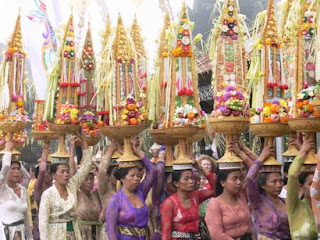
Pegatuakan ceremony is celebrated by presenting some offering to the merajan or sanggah (family temple) and to the Kahyangan Tiga (three main temples in every village). A parade of women carrying offering on their head can be seen today on every road in south Bali. Temples will be decorated with colorful fabrics and symbolic ornaments made of young coconut leaves. The scale of pomposity and the size of offering are equal with the Galungan (Balinese Christmas) ceremony. Moreover, today is full moon, a holiday that happens together with full moon (Purnama Kapitu) will be considered as a Nadi, grand holiday. Of course, the offering and pomposity of grand holiday is bigger than ordinary holiday.

Only the Balinese in south Bali celebrate the Pegatuakan ceremony in great pomposity. Balinese in north Bali do not celebrate the Pegatuakan ceremony as pompous as their colleagues in south Bali. In some area in north Bali, there is no celebration today.

This kind diversity is common in Bali. There are great and various diversities on the religious aspect among hundreds of villages in Bali. The concept of Desa, Kala, Patra (place, time, and circumstance) is the sole base of this diversity. Balinese believe that every village has its own way on celebrating and preparing a ceremony, range from the kind of offering to kind of ceremony which is celebrated (some offering are used in a certain village but not in other one, a ceremony is celebrated in village A but not in village B). A phrase ‘the way it is in Bali’ is totally nonsense.

Dr. Hildred Geertz the author of ‘Kinship in Bali‘ desperately said ‘a law in a village is exception in the next‘, a statement that clearly define the uniformity in Bali.

from : blogbaliwww

Read more...

Religions and Belief

Outside of India, Bali is the largest Hindu outpost in the world. On Bali Hinduism has developed along lines all its own. In fact, the way in which Balinese practice their frontier Hinduism is still their greatest art.
Rather than being 'characters', the Hindu gods are experienced as abstractions associated with natural forces: Wisnu with rain and nurturing, and Brahma with creativity, fire and volcanos. 
  
Balinese pantheon still includes sacred powers specific to Bali, usually under the term of Bhatara, or god. Here are the most prevalent of these specific gods. 

The Supreme God: Sang Hyang Widhi Wasa is the ' One Supreme Unknowable God',

Ancients kings: they are also influential deities,

Deified Ancestors: they are the most intimate gods. The relationship between a Balinese and his ancestors is at once reverent and practical. The souls of the dead can be absorbed into heaven only by the purification rites of the living. In return, the ancestors bestow blessings and sometimes advice through trance mediums. Bhatara kawitan is the term for the original clan ancestor.

Gods residing in nature: the most powerful are those associated with mountains, lakes, and sea. Ida Bhatara Gunung Agung is the god of Mount Agung; Ida Bhatara Dewi Ulun Danu Batur is the goddess of Lake Batur crater. The one of the sea has no specific name but segara which means 'sea'. 

Dewi Sri.
The beloved goddess of rice, Dewi Sri is the anima of a rice cult of particular beauty. Her shrines in the rice fields are simple structures of virgin bamboo. Her realm includes granaries and the rice basket, and she is honored in a number of different cyclical rituals, including the daily offerings set out after cooking.

Saraswati.

Saraswati, consort of Brahma, is the goddess of Knowledge, wisdom, and the arts. She is usually depicted as a beautiful, richly dressed woman riding a goose. Her anniversary falls on the 210 days Balinese calendar, when offerings are made to books, and reading and writing are nit allowed.

from : discover-indo.tierranet

Read more...

Kecak Dance

>> Monday, 2 February 2009


Kecak (pronunciation: / 'ke.tʃak /, roughly "KEH-chahk", an alternative spelling: Ketjak, Ketjack, and Ketiak), is the Balinese performing arts that was created in 1930 and played an especially by men. Dance this be by many (tens or more) male dancers who form a circle and sat down with the rhythm called a "smack" and the second arm, describes the story of Ramayana monkeys help line at Rama against Rahwana. However, Kecak sanghyang derived from the rituals, the tradition of dance penarinya are not aware of the condition [1], making communication with God or the spirit of the ancestors and the hope-and hopes to the people.

The dancers sit around the cloth is put on the boxes, such as chess boards around their waist. In addition to the dancers is, there are the other dancers who portray characters such as the Ramayana, Rama, Shinta, Rahwana, Hanoman and Sugriwa.

Kecak dance songs taken from the ritual dances sanghyang. In addition, the tool does not use music. Only used kincringan charged on foot dancers portray the figures Ramayana.

Around 1930, an Wayan Limbak working with the German painter Walter Spies create Kecak dance tradition based on Sanghyang and parts of the story of Ramayana. Wayan Limbak popularize dance this time around the world with the group of its dancers Bali.

Read more...

About this Blog

tourism cultural or indonesia
   

  © Free Blogger Templates Joy by Ourblogtemplates.com 2008

Back to TOP